domingo, 19 de agosto de 2018

14 Ways to Safely Hitchhike Across the United States

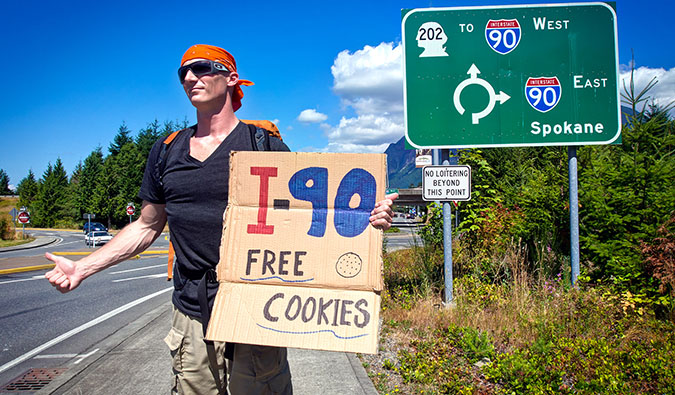
Matthew Karsten hitchhiking in the USA holding a sign offering free cookies
Updated: 8/18/18 | August 18th, 2018

My first experience with hitchhiking was in Belize. Back in 2005, I hitchhiked the entire country, as it was the most common way locals got around. If they were doing it, why not me? It was a lot of fun and much easier and safer than I thought it would be. Since then, I’ve hitchhiked around a handful of countries and met some interesting (and not so interesting) people. Hitchhiking is still a popular and common way many people worldwide get around, but it evokes a lot of fears and concerns, especially among Westerners. Today, Matt Karsten from expertvagabond.com shares his experience hitchhiking around the United States and advice about how you can safely do it too. Enter Matt.

It was a chilly and overcast day on the Oregon coast when I nervously stuck my thumb out on the side of Route 101. For the next 20 minutes, drivers passed me over and over again — most with looks of disgust on their faces. But I kept on smiling. Would anyone stop for me? Was I wasting my time? I wasn’t completely sure.

Eventually my persistence paid off, and a massive orange pickup truck screeched to a stop in a cloud of dust. A wave of excitement rushed over me as I jogged up to meet CJ and her dog, Trigger. My first ride!

Yet this was just the first of many such pleasant surprises on my journey.

CJ wasn’t going far, only to the next town. When I asked why she stopped, she explained that I looked relatively normal and that she’d also done some solo hitchhiking in Montana when she was younger. This would become a common theme over the next five weeks. Drivers will often stop for you to pay back kindness they received in the past.

Before I left on my mission to hitchhike across the United States from coast to coast, I was told that no one picks hitchhikers up anymore. They said that it was dangerous these days, and that the golden era of hitchhiking was, sadly, over.

But after five weeks, 3,500 miles, 36 rides (from both men and women), a motorcycle, a boat, an airplane, a freight train, and a tractor trailer, I can say that those people were wrong. If you’ve always dreamed of hitchhiking but are unsure of how to do it, where to begin, and how to stay safe, here are 14 tips to hitchhike smart:

Be Confident

Always look drivers in the eye and smile as they pass. Not in a crazy axe-murderer way, but in a friendly and personable way. Smiling is very important. Pretend the next car is a friend who is planning to pick you up. Try waving hello or holding your gaze expectantly as they drive past. You really only have a second or two to make a positive impression. Think of it as a drive-by job interview, with only your eyes, appearance, and body language to guide the other person’s decision. Smiling for three hours straight in the sun or rain despite a constant stream of rejection is not easy, but you’ll get better at it. If you look nervous or scared, you will attract the wrong type of people, so be confident.

Look Presentable
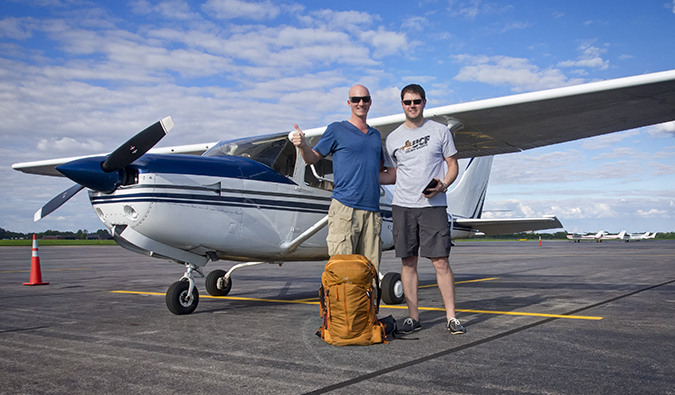
Two guys posing in front of an airplane with a backpack and a thumbs up
No one wants to pick up a lazy, stinky-looking hobo. Dress in light or bright clothes. Avoid wearing black if you can. Don’t wear sunglasses (people need to see your eyes), and keep your hands out of your pockets. Don’t smoke, drink, or sit down on the side of the road.

Additionally, many drivers pick up people who look similar to themselves. I was having a difficult time getting a ride on the border of Colorado and Kansas until I bought myself a cheap cowboy hat! Soon after that strategic purchase, a trucker couple from rural Tennessee pulled over and proceeded to drive me 1,200 miles over the course of two days, country music playing all the while.

Choose a Good Spot
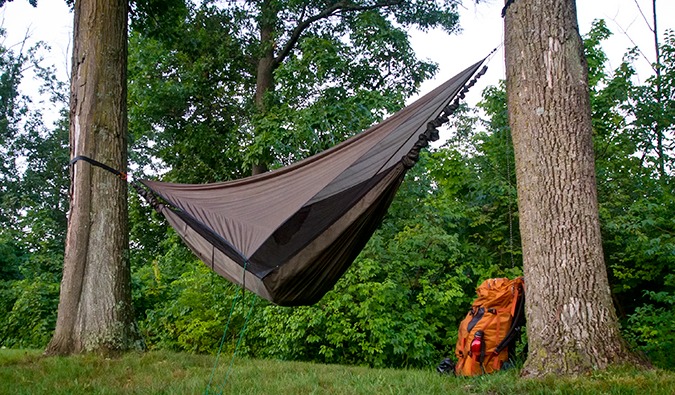
A hammock tied between two trees and a backpack sitting on the ground
Cars will not stop for you if they can’t do it safely. Interstate on-ramps are great because cars aren’t moving very fast and there’s usually room to pull over. Other good locations include intersections with stoplights or a stop sign and gas stations. The longer a driver can get a good look at you, the better. Keep an eye out for shady areas with protection from the sun, too. If you have Internet access on your phone, Google Maps in satellite view will show you where the best on-ramps are.

Hitchhiking out of big cities can be very difficult, and sometimes using public transportation to get to the outskirts is your best option. There are some places where it is almost impossible to get a ride, such as spots near sensitive government facilities (employees are forbidden to pick people up), prisons, or neighborhoods with high crime rates.

Make Conversation

There are many reasons why people pick up hitchhikers. Maybe they’re bored and want to listen to fun travel stories. Maybe they were once hitchhikers and want to share their experience (and karma) with you. Maybe they’ll try to convert you to Christianity/Islam/Scientology. Maybe they need help staying awake on a long drive.

Providing good conversation is how you pay these people back for their generosity. It can also lead to a free lunch, drinks, or maybe even an offer to host you for the night. Ed the yacht builder was the last ride on my cross-country journey, and he spent his whole afternoon giving me a personal tour of the Maryland coast before taking me out for dinner and drinks at his favorite seafood restaurant.

Be Prepared

Always pack enough food and water to last a day, in case you get stuck in the middle of nowhere. I like to bring a few bananas, apples, tortillas, tuna, refried beans, and maybe a package of cookies to share. A filtered water bottle will let you safely drink from rivers and ponds. Take a couple of dark-colored permanent markers to create signs, some sunscreen, a first aid kit, warm clothes, and a rain jacket.

A USB car charger and external battery for your mobile phone is a good idea too. They’re perfect for listening to music, checking Google Maps, or calling for help in an emergency. A lightweight camping hammock or bivy sack will help you save money on accommodations. I frequently camped in the woods on the side of the road or behind churches on my trip.

Use a Cardboard Sign
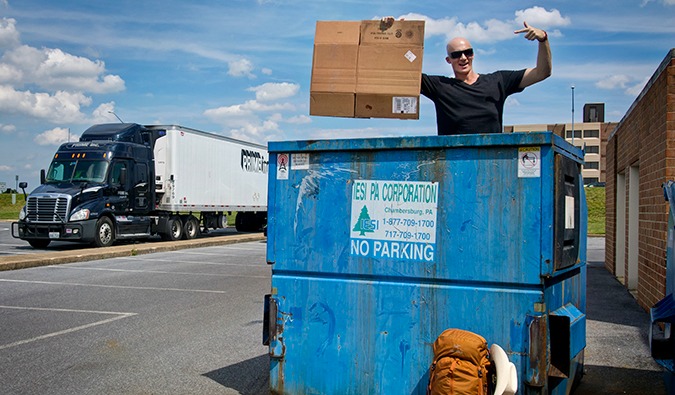
Guy in a dumpster holding up a piece of cardboard for his hitchhiking sign with a truck passing
A simple cardboard sign indicating a town nearby helps a lot. Keep it short and write in large capital letters with a Sharpie marker. It needs to be readable at a distance from a fast-moving vehicle. Use destinations that are relatively close (within 20–50 miles), and you’ll be more likely to score rides. You can then negotiate longer ones inside the vehicle if the driver is going farther in your intended direction.

Funny signs work well too. A few successful ones I used were: “Free Cookies,” “Won’t Kill You,” and “Rabies-Free Since June.” That last sign was funny enough that Dan, a retired theater actor and pharmaceutical executive, had already driven to the next exit when he changed his mind and turned around to come get me!

You can find cardboard for signs at any gas station or fast-food restaurant, either by asking inside or by opening up the dumpster in the back.

Choose Your Ride Carefully

You are under no obligation to get into every car that stops for you. Is the driver in a good mood? Are they looking you in the eyes? Are they sober? How many people are in the car? If you don’t feel comfortable accepting a ride, thank the driver and say no. Make up an excuse if you have to. Pretend to be sick, or explain that you’d rather wait for a longer ride. Trust your gut instincts. On my own trip, I only turned down one ride. I was in a sketchy neighborhood (prostitutes were walking around in the middle of the day), and the vehicle that stopped was a truck packed with four young guys, with the smell of weed pouring from the windows. They were also only headed to the next exit. Odds are good I would’ve been fine, but the situation didn’t feel right and I decided to wait for a better opportunity.

Use Common Sense

Always wear your seatbelt, and if the person starts driving erratically, stay calm and polite but ask to be let out at the next safe pullover spot. Avoid hitchhiking (or picking up hitchhikers) at night. Not only is it very difficult to stop on the side of the road safely after dark, but it’s also much harder to see pedestrians at night. Not to mention, people are much more likely to commit crimes under the cover of darkness.

Stay Positive
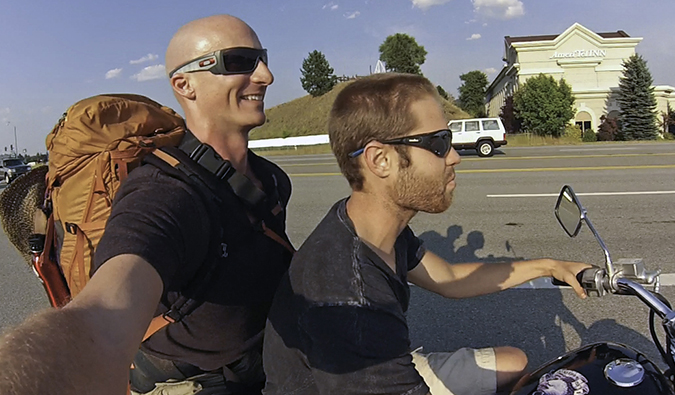
Two guys on a motorcycle, on a motorcycle owner, the other is a hitchhiker in America
Hitchhiking is definitely a mental challenge. You’re putting yourself out there in public while engaging in an activity that isn’t considered mainstream. You’ll be judged by everyone who passes you, often in a negative way. People will laugh, flip you off, yell, honk, rev their engines, or maybe even throw things.

Stay in Control

Predators prey on weakness and insecurity. Don’t make yourself an easy target. Dress conservatively and steer sexual topics to something unsexy. Make it crystal clear you’re only interested in getting to your destination, and nothing else. Maintain an aura of confidence.

Keep your valuables on or near your body so if you must escape quickly, you don’t lose them. Avoid putting your bag in the trunk if possible, so the driver can’t take off before you can grab it. Snap a quick photo of the back of the car with your phone before you get in, then send it to a friend or your Twitter account. Once inside the car, find a moment to call a friend and tell them where you are and where you’re headed so the driver can hear you doing it.

Avoid Arguments
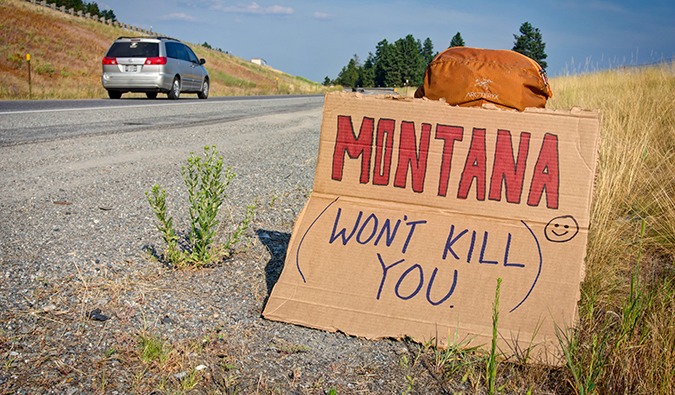
Hitchhiknig sign saying that Montana Won't Kill You
Try to avoid talking to your driver (or hitchhiker) about politics, religion, race, or other controversial subjects, at least until you get to know each other a bit and can gauge how they might react. You don’t want to provoke them into becoming angry or emotional while behind the wheel. If they attempt to start a conversation on these topics, try to change the subject or give boring/vague answers to their questions until they lose interest or you feel comfortable talking about them. This is how I responded to Captain Kitty Litter’s overly racist remarks and questions. Even though I disagreed with his views, I just kind of nodded along and let him talk.

Hitchhike with a Friend

If it’s your first time hitchhiking and you’re particularly nervous about it, try hitching with someone else who’s done it before. This is a fantastic way to learn the ropes and get more comfortable. While it might be more difficult to get someone to stop for two hitchhikers, it will always be a bit safer. I’m not saying not to go alone, but if you’re worried about safety, hitchhiking with a friend might be a good way to start out.

Expect to Wait
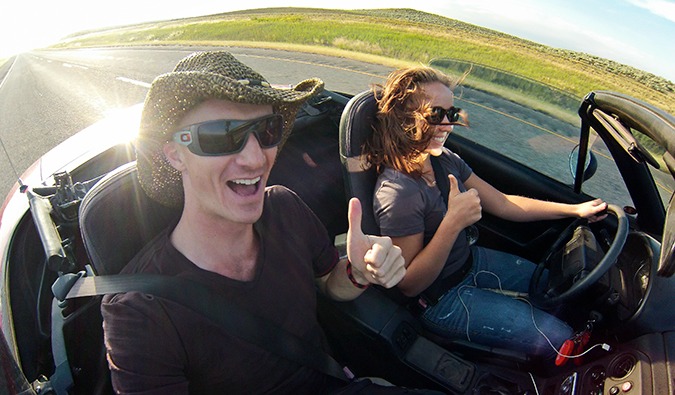
Male hitchhiker with a female driver riding along the road in a top-down convertible
My average wait time while hitchhiking across the United States was about an hour. But there were some days when it took 2–3 hours or more. You must be prepared to wait in one spot for at least a few hours. However, there were also many times when I was picked up after only 15 minutes. You just never know how long it will take.

If you’re in a particularly bad spot, it might take days to get picked up, which happened to me once outside Denver. I spent two nights in a motel waiting to get out of there. Are you getting sick of waiting? Maybe take a break and go do something else to break up the time. Having camping gear with you can help in these situations too. Walking a few miles to the next exit or catching a taxi to a better location are also options.

Protect Yourself

You will almost certainly never need to use it, but packing a weapon of some kind to help with self-defense is always a good idea. I like to bring pepper spray along with me. When Captain Kitty Litter started telling me about the time he threw another hitchhiker out of his moving car, I subtly placed one hand in my pocket where pepper spray was hidden (just in case). Luckily I never needed to use it!

My experienced hitchhiker friend Shannon carries a stun gun openly on her belt (this can be illegal in some states). However, a simple pen shoved into the ear or eyes of an assailant should work in a pinch too. In my opinion, a knife should not be your first choice for self-defense unless you’ve been trained to use it, as it can easily be turned against you if the situation takes a turn for the worse. Please note that using a weapon is an absolute last resort — only use it when communication doesn’t work and you honestly fear for your life.

Is Hitchhiking Safe?

Hitchhiking has become progressively more rare over the years. Irrational fears about hitchhiking are brought on by paranoid horror stories promoted aggressively by the news and then turned into movies by Hollywood. Bad news is what sells, so that’s what we’re exposed to. I’m still waiting for CNN to do a story about my successful hitchhiking adventure, but I’m not holding my breath. I had a wonderful time, met great people, and nothing bad happened. It’s not sensational enough to be considered news.

Based on my own experience and after listening to other people’s hitchhiking stories, it’s likely that some weirdos will pick you up. But rarely will it result in a dangerous situation. Out of 36 different rides during my own adventure, I had maybe two or three “odd” (socially awkward) drivers.

I was told countless times that hitchhiking would be dangerous. While it’s smart to be prepared for worst-case scenarios, in reality you don’t have to worry about these horror stories too much. Most of the people I met while hitchhiking were friendly, fascinating, and full of entertaining tales. But that doesn’t mean you should let your guard down.

While hitchhiking is not nearly as dangerous as some people make it out to be, there is risk involved. If you choose to engage in this activity, you are accepting those risks. Crimes are committed against hitchhikers from time to time, as well as against drivers (although much less frequently).

If you ever feel threatened or uncomfortable once you’re already in the vehicle, first ask the driver to stop and let you out at the next exit or gas station. Make up an excuse if you want to. If the driver still fails to stop, remind them that you sent a photo of the car and plate number to friends. In an absolute emergency, you can always grab the steering wheel or handbrake and cause a small accident. Remember, only use these techniques as a last resort, when you genuinely fear for your life. Even small accidents can kill you or someone else. It’s not something to take lightly.

One Final Legal Note

Hitchhiking in the United States is legal. The confusion lies with the United States Uniform Vehicle Code. The law states:

“No person shall stand in a roadway for the purpose of soliciting a ride.”

Sounds illegal, right? Yes — until you read its definition of “roadway:”

“That portion of a highway improved, designed or ordinarily used for vehicular travel, exclusive of the sidewalk, berm or shoulder even though such sidewalk, berm or shoulder is used by persons riding bicycles or other human powered vehicles.”

What does that mean? It’s illegal to stand directly on the road (for obvious safety reasons), but standing on the side of the road, the shoulder, or a sidewalk is fine.

Each state also has its own laws, though, and a few specifically ban hitchhiking. These include New York, Nevada, New Jersey, Pennsylvania, Utah, and Wyoming.

However, getting caught hitchhiking in these states doesn’t necessarily mean you’ll go to jail. Police officers may stop and question you, give you a warning, or fine you. In fact, hitchhikers may experience this from authorities even in states where it is technically legal, due to ignorance of the law or boredom.
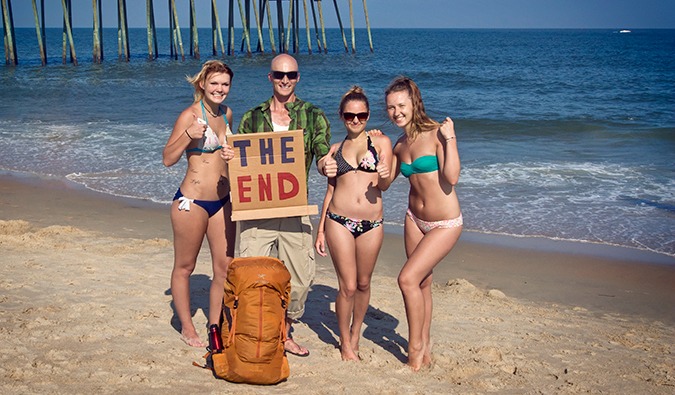
Man standing on the beach with 3 girls in bikinis and a cardboard hitchhiking sign saying THE END

Hitchhiking will definitely be a challenge. But it will also open your mind, build your confidence, teach you patience, and introduce you to new friends. There’s something magical about the open road and the uncertainty that comes with sticking out your thumb with no plans.

You could meet a friendly schoolteacher who’s never picked anyone up or an ex-con with hilarious stories to share. Or maybe you’ll meet the inventor of the Ultimate Pancake Sandwich. I was picked up in fancy Land Rovers, an airplane, a boat, a motorcycle, and a car held together with duct tape. You don’t know who will stop, if anyone will stop, or how your day will unfold when someone eventually does. That’s what makes hitchhiking so special. It’s the unknown.

It’s an absolute roller coaster ride full of emotions: thrilling one minute, then completely discouraging the next. But in the end, hitchhiking might just be one of your most memorable or rewarding travel experiences, as it has been for me. I’ll never forget the feeling of accomplishment I experienced when jumping into the Atlantic Ocean at the end of my long journey.

Useful Resources for Hitchhiking

For more information on the legality of hitchhiking, trip reports, organized meet-ups, and route maps from around the world, check out HitchWiki.org and Reddit Hitchhiking.

To locate accommodations while hitchhiking, you can use Couchsurfing.org to meet local people willing to share their homes with strangers in exchange for interesting conversation. You will surely be able to provide some after a few days of hitchhiking.

Matthew Karsten has been vagabonding around the world since 2010. Addicted to adventure travel and photography, he’s on a mission to inspire your next journey with entertaining stories and images from his travels. Read more about his five-week hitchhiking journey across America at ExpertVagabond.com.

Book Your Trip: Logistical Tips and Tricks

Book Your Flight
Find a cheap flight by using Skyscanner or Momondo. They are my two favorite search engines. Start with Momondo.

Book Your Accommodation
You can book your hostel with Hostelworld. If you want to stay elsewhere, use Booking.com as they consistently return the cheapest rates. (Here’s the proof.)

Don’t Forget Travel Insurance
Travel insurance will protect you against illness, injury, theft, and cancellations. I never ever go on a trip without it. I’ve been using World Nomads for ten years. You should too.

Need Some Gear?
Check out our resource page for the best companies to use!


The post 14 Ways to Safely Hitchhike Across the United States appeared first on Nomadic Matt's Travel Site.


August 19, 2018 at 12:49AM

fom https://ift.tt/2vBlpHt
by IHholiday Travel trip

martes, 14 de agosto de 2018

The Flying Tomatoes of La Tomatina

Crowd covered in red tomatoes during the La Tomatina festival in Spain
Updated: 8/14/2018 | August 14th, 2018

Everybody loves a good festival. They are a chance to let loose, have fun, and indulge in something crazy.

And the only thing more crazy than a giant festival?

A giant food fight.

And there’s nothing better than La Tomatina in Bunol, Spain for that!

What originated as an impromptu local food fight among friends in 1945 grew to become its own cultural event — and the world’s largest food fight. Since 1945, La Tomatina has became a yearly occurrence in Bunol, Spain (aside from a few years in the 1950’s when it was banned under Franco). It takes places every year on the last Wednesday of August, and upwards of 30,000 tourists some to take part in this massive food fight.

Starting early in the morning, people wearing clothes never to be worn again crowd trains heading from Valencia to Bunol. They get there and join the masses heading to the city center, stopping on the way for some food and (a lot of) drinks. Eventually, everyone reaches the city center and simply stops. There’s nowhere else to go. The crowd is simply too thick.

During the run-up to the 11 am kick-off, many participants compete in a pole climb, where they scramble up a greased pole to win a ham. Once the ham is captured, the party official “starts” (though I didn’t see anyone get the ham so you can be sure that the party is starting at 11 am no matter what).

Nothing I write will give justice to this ridiculous festival, which is why I brought my camera along when I attended! While I was fighting away, my friends at Travelyourself took my camera so I could bring you this:

The fight lasts for one hour after which the city is ankle-deep in a river of tomato juice. The fire department will come out shortly thereafter and hose down the city (which when combined with the citric acid in the tomatoes actually does a nice job of cleaning the place!). Partygoers tend to head down to the river to clean up and wash off (or you can get hosed down by one of the locals and their kids who love spraying everyone). The party continues the rest of in many of the plazas around the city. There’s music, dancing, copious amounts of sangria, and lots of good food. This goes until sunset when most crowds head back to Valencia.

It is one of the best times I’ve ever had. In the crush of the crowds, you’re just throwing tomatoes left and right at anything and everything – barely looking where you’re going. I watched people climb statues and doorways for better angles only to turn themselves into easy targets for those nearby. Afterwards, our friends jovially skipped to down and spent the rest of the day on a high partying and chatting with everyone.

Some Tips for Attending La Tomatina

Planning to attend this epic food fight? Here are a few tips to help you make the most out of your trip:

  • Wear clothing you’re ok with throwing out. Chances are it’s not going to recover (including your shoes!) Many clothes get torn, stained beyond repair, and just end up smelling for days after. Don’t bring anything nice.
  • If you’re a woman, be on the lookout and wear a sports bra as many guys get grabby and often times try to snap bras off.
  • Don’t bring any valuables like your wallet or passport as you might lose them. Plus, petty crime is rife here. It’s easy to get into people’s pockets. Wear a money belt or a ziplocked poach around your next.
  • Only bring your camera or phone if is waterproof. Even then, make sure it has a protective case!
  • Wear goggles. You don’t want to get tomato juice in your eyes.
  • If you’re traveling with friends, agree on a place to meet afterward. There’s a good chance you might lose them in the crowd.
  • Arrive early as there’s limited space!
  • Don’t wear flip flops or sandals. The ground gets slippery fast, so you want good shoes to keep you upright. The right crowds also mean people will step on your feet all the time!
  • Stay hydrated. It’s going to be super hot in August, and there will be people everywhere. Drink up before the fight so you can fling tomatoes without getting dehydrated.
  • Watch for shirt rippers. There is a tendency for people (who may have had a bit too much to drink beforehand) to try and rip the shirt off your back. It’s against the rules of the festival, but people will still try to do it so be aware!
****

La Tomatina was certainly the most interesting festival I’ve been to. It’s quite dirty (obviously) and if you don’t like a mess or crowds, chances are you won’t like this! But I had an amazing, energetic time, and my time there connected me with some of the most important people in my life. There’s something that bonds people throwing vegetables with each other. So for those looking to spend a few hours throwing food, dancing in the streets, and drinking sangria, visit La Tomatina!

How to Get to La Tomatina

Bunol is located around 40km outside of Valencia. To get there from Valencia, you have 3 options:

  • Drive – It’s about a 40-minute trip by car. If you don’t want to rent a car yourself, try using Blablacar (a ride-sharing app)
  • Bus – The bus #265a, #265b, and #2 go from Valencia. The ride takes between 60-75 minutes. Round-trips tickets will cost just under 8 EUR.
  • Train – Take the C3 from Valencia. Tickets will cost around 4 EUR each way and it takes slighlty over an hour.

As of 2013, foreigners wishing to take part have to pay 10 EUR for a ticket.

Book Your Trip to Spain: Logistical Tips and Tricks

Book Your Flight
Find a cheap flight to Spain by using Skyscanner or Momondo. They are my two favorite search engines. Start with Momondo.

Book Your Accommodation
You can book your hostel in Spain with Hostelworld. If you want to stay elsewhere, use Booking.com as they consistently return the cheapest rates. (Here’s the proof.)

Don’t Forget Travel Insurance
Travel insurance will protect you against illness, injury, theft, and cancellations. I never ever go on a trip without it. I’ve been using World Nomads for ten years. You should too.

Need Some Gear?
Check out our resource page for the best companies to use!

Want More Information on Spain?
Be sure to visit our robust destination guide on Spain for even more planning tips!

The post The Flying Tomatoes of La Tomatina appeared first on Nomadic Matt's Travel Site.


August 14, 2018 at 03:00PM

fom https://ift.tt/2OyydV2
by IHholiday Travel trip

The Best 10 Travel Apps of 2018

10 amazing travel apps
Updated: 8/13/2018 | August 13th, 2018

There’s no shortage of travel apps cluttering up the Android and Apple marketplaces these days — and that’s a problem, as most of them are terrible. Sorting out useless ones from those worth installing is not the most fun you’ll ever have with your smartphone, and no one wants to pay for a worthless app.

If you’ve got a trip coming up, rather than wasting a week of your life downloading useless junk, start with these 10 great travel apps instead.

LoungeBuddy

Loungebuddy logo for the travel app
I’ve spent enough of my life waiting around in airports to know that it basically sucks. I usually fly on budget airlines with long layovers and terrible connections so dirty seats, expensive Wi-Fi, and bad food are a depressingly regular part of my life. The only places that offer any respite are the lounges — but without a membership or business-class tickets, I’m not inclined to wander around and ask random lounge staff if they’d like to let me in.

LoungeBuddy takes the pain out of the process. After entering your credit card, airline status, and lounge memberships, the app tells you which lounges you can access at any given airport. Even for people like me who don’t have any of those things, the app still lets you know about any free lounges or where you can purchase a day pass for. It’s slick, easy to use, and free!

Get it for iOS.

AirHelp

AirHelp logo and image for travelers
If you’ve ever endured the pain of a delayed or canceled flight, or been denied boarding because of overbooking, AirHelp will be right up your alley. Both US and EU laws provide for compensation in such cases, although the details differ. It’s a complicated process, though, and apparently less than 1% of passengers entitled to compensation ever get it.

This app makes the process simple and something you can do in a few minutes while still waiting around at the airport. Just enter your flight information and a few details about the problem, and the company takes care of the rest. If the claim is successful, they take 25% of the payout and you get the remainder. You also get a referral bonus for anyone else on your flight that you send the company’s way.

iOS / Android

Hostelworld

Hostelworld advertisement for traveling people
The Hostelworld app has does all the usual things you’d expect an accommodation booking app to do — searches, descriptions, filters — and looks particularly good while doing so. The full-screen interactive map makes it easy to work out whether the hostel you like is anywhere near where you want to be, while those all-important reviews are only a tap away.

Hostelworld is available for both iOS and Android.

Airbnb

Airbnb
Airbnb lets you rent individual rooms, couches, or an entire apartment from locals. I love Ainnb as it’s a good happy medium between hostels and hotels. Plus, if you stay with local hosts, you’ll still get the social aspect of a hostel. The app does everything the website does but at the tip of your fingers. I find it a lot more effective way to communicate with your host.

You can get Airbnb for both iOS and Android.

Skyscanner

Skyscanner
Skyscanner is my preferred method for finding cheap flights. The mobile app searches millions of flights from over 1,200 sources and then gives you the best options available (whether it’s the cheapest route, or the easiest one). The handy chart feature lets you look at the cheapest days or months to fly to your destination as well as send you notification of price changes.

The Skyscanner app is available here.

HotelTonight

Hotel Tonight
HotelTonight gives you amazing last minute discounts on empty hotel rooms. It’s incredibly easy to use app and it doesn’t take long to reserve a room. You can search by city, attraction, or on the map, and then check out the reviews and photos from other travelers. They also have 24/7 customer support. When I’m stuck in a place and need a last minute room, this is the app I use.

Available for iOS and Android

TripIt

TripIt
TripIt helps organize your upcoming travel itinerary. All you have to do is forward your hotel, restaurant, flight, and car rental confirmation emails to plans@tripit.com and it automatically transfers all the information in your master itinerary, so that you can easily view all your upcoming plans at once. If you upgrade to the pro version, the company will find you alternative routes for when your flights get canceled as well as send you automatic notifications from airlines about flights delays, cancellations, and more. If you travel a lot and have a lot of bookings you need to organize, this is the best app to do it.

TripIt is available for iOS and Android.

OpenRice

OpenRice
OpenRice is the Yelp of Asia. It shows a city’s most popular restaurants, ratings, menus, booking numbers, and everything in between. It’s widespread in Southeast Asia and a better resource than Yelp. They have listings for Hong Kong, Malaysia, Indonesia, Singapore, Thailand, and the Philippines. The app puts the power of their website at your fingertips.

OpenRice is available on Android and iOS.

Detour

Detour app
Detour is a fantastic GPS guided audio walk that offers an immersive experience in 17 cities around the world. Each audio tour is narrated by a local who knows the city inside out, so you’ll be getting beneath the surface of the place. Currently, they have tours for San Francisco, New York City, Los Angeles, Austin, Washington DC, Boston, Portland, Savannah, Charleston, Chicago, Rome, Berlin, Marrakech, London, Paris, and Barcelona.

Detour is available for iOS and Android.

Trail Wallet

Trail Wallet
Trail Wallet is an easy travel expense tracker. I used to have an app similar but it was too hard to update. This app is now the best. It takes the headache out of expense tracking. You can organize your expenses by trip or by month, set a daily budget, and easily add expenses. When you get a bill or receipt, pull out your iPhone, add the amount using the Quick Add screen and you’re done.

Trail Wallet is available on iOS.

***

The app world is a constantly changing place, and there are many travel apps out there already that take the pain out of travel. They help you travel better, cheaper, and longer. The above travel apps are some of the best travel apps in 2018 and are worth downloading to your phone before your next trip.

The post The Best 10 Travel Apps of 2018 appeared first on Nomadic Matt's Travel Site.


August 13, 2018 at 06:25PM

fom https://ift.tt/2BcHWP6
by IHholiday Travel trip

jueves, 9 de agosto de 2018

5 Ways Make Your Money Last When You Travel

A little bit of money can go a long way when it comes to travel
Updated: 8/5/18 | August 5th, 2018

One of the most common questions I get asked about my ability to travel long term is how I can afford to travel so much? Am I rich? Did mom and dad pay? Do I have a rich uncle? Did I win the lottery?

Before I was able to transform this blog into a business, I spent years traveling the world by doing one thing: I watched where my money went.

That’s it.

It’s simple and boring.

At the end of the day, just like there’s there’s no secret to travel, there’s also no real secret to making your money last on the road either.

The way to make your money last is to be smart and realistic about your budget, and to do your research.

It’s boring, but it’s true.

When I first started traveling, I pinched every penny and saved money every chance I got. While I sometimes lavishly spent money like it was going out of style, I made up for it on other days by staying in and cooking pasta.

In short, I balanced my budget.

I kept a journal on what I spent so I could track my spending and sure I was staying on budget. (I love when I see travelers keeping a spending journal to track their budget. Those are the travelers who end up staying on budget!)

While on the road (just like at home) there will be unforeseen circumstances that chip into your savings like missed flights, a lost camera, or a change in plans that leaves you having to pay extra for accommodation. You can’t avoid these sort of things, but you can plan for them. You can be prepared, know your budget, and make sure you can afford your travels.

Here are 5 ways to make sure you never run out of money for your trip:

Step 1 – Know what you want to spend money on

When I travel, I don’t budget a lot of money for accommodation, tours, or even transportation. I find the cheapest accommodation around and I walk everywhere I can. If I need a ride, I’ll take public transportation or hitchhike!

But I will spend a lot of money on food and drinks. Why? Because that’s what I want to do! I didn’t pinch pennies back home and avoid going out so I could fly to Australia and spend my nights watching Netflix, nor did I head to France just to cook meals in a hostel every night. No, not me. I came to live! I came to eat and drink in the culture! I want to go out.

And I’m willing to sleep in massive dorms, on a floor, or walk seven miles to ensure I have the funds to make that happen.

If you can eat all your meals in a hostel kitchen then a small food budget is for you. If you plan on couchsurfing every night of the week, then you don’t need to account for accommodations. If you are flying to Europe and know you love to drink wine, you should expect that you’ll probably buy some wine.

Be realistic about what you want to do with your travels and budget accordingly.

Step 2 – Research and plan before you go. 

When you know yourself and what you want to spend money on, it’s easy to create a robust budget that will cover you for the duration of your trip. This is where pre-trip research comes in. Will you be taking any tours or cooking classes? Going bungee jumping or dancing the night away at a club?

Once you know your interests (at least a bit), you can set your budget.

When I started planning my trip in 2005, there wasn’t a lot of travel information online. I spent a lot of time reading guidebooks and searching for any information I could find about prices. I pieced together an intricate spreadsheet of how much I would spend each day in various places based on how much I could save and what I found online.

These days, you don’t need to go that crazy when you plan your trip because there is so much information available online about prices. You can literally Google the price for anything you want!

If you want to make your money last, you need to know exactly how much you think you’ll spend.

Too often I see travelers get blindsided by unexpected costs, breaking their budget to pieces. Sure, something will always happen that you don’t predict, but people mostly get blindsided by stuff they should have anticipated. “Wow! That tour is so expensive. I blew my budget!” “I didn’t expect drinks would cost so much!” “This place is more expensive than I thought.”

I just shake my head when I hear these comments because these are people who clearly didn’t do any planning.

Don’t be like these people. Do your research, plan ahead, and avoid the pitfalls that will send you home far sooner (and far poorer) than you want.

Step 3 – Create your ideal budget.

Create a budget for what you think travel will cost. Write down all the things you want to do, where you want to do them, and how much they will cost. Account for your food, insurance, transportation, flights, accommodation, booze, activities, and anything else you think will be relevant.

If you need help budgeting or don’t know how much something will cost, ask someone from our online travel forum or someone in our travel Facebook group — somebody will definitely be able to help!

Step 4 – Match your expectations to your economic reality.

I cut a lot from my ideal budget and itinerary based on how much I knew I was going to actually save for my trip. If I wanted to do things that totaled $10,000 USD but was only going to save $7,000 USD, then I had to make cuts to match my financial reality. Here are some good articles on saving money to help you:

Step 5 –  Keep track of all your expenses.

Finally, after you have created your realistic budget and set out on the road, you need to track all of your expenses. The people who have to go home early are always the ones that have no idea how much money they are spending on the road.

By tracking every expense — from hostel dorms to that snack you bought — you can see if you’re on track or if you’re overspending (in which case you can correct your spending).

This is the most important thing you can do make your money last!

If you only do one thing, track your spending! Sure, you have to remember to do it, and it’s easy to forget, but actively doing this will ensure you become a better budget traveler, and soon it will become a habit.

You can keep track of it all in a journal, or use an app like Mint or Trail Wallet.

***

Your budget will only last as long as you planned it to last. If you plan your budget well, it will last until the end of your trip. No matter what you do, write down your expenses!!! Keep track of your expenses will allow you to make adjustments as you go and ensure your travel money lasts as long as you want.

Do I ever go over budget? Of course. But I make up for it on other days. Because it’s a lot easier to make up an extra drink than a tour to Great Barrier Reef or constantly going over your accommodation budget. By planning and tracking like a financial ninja, those things are not likely to happen. That means more days on the road, more adventures, and more awesome travel experiences.

The better you know yourself and create a budget based on that, the longer your money will last when you travel!

The post 5 Ways Make Your Money Last When You Travel appeared first on Nomadic Matt's Travel Site.


August 05, 2018 at 05:58PM

fom https://ift.tt/2npD3Z8
by IHholiday Travel trip

The Saturday City: Philadelphia

Philadelphia skyline
Updated: 8/9/2018 | August 9th, 2018

Philadelphia. The City of Brotherly Love. It’s home to the Constitutional Convention, the World Series-winning Phillies, swing state voters, the Rocky Balboa statue, and greasy (but delicious) cheese steaks. It’s a historic city that offers plenty of opportunities for the history buff to geek out. But there is more than just history here. Philly is a modern, vibrant city worth spending time exploring. I’ve visited many times over the years, as I have family there. Growing up, family trips were frequent so I got to know the city well. And when I was older, it was a stop on my cross-country tour.

Philadelphia is actually one of the oldest and most historic cities in America. Its central location within the 13 colonies made it an ideal location for early American leaders to meet to discuss the future of the colonies. Eventually those discussions led to the revolt against England and the founding of the country. However, its history is goes back even further.

In 1681, Charles II of England granted William Penn a charter for what would become the Pennsylvania colony. Penn’s plan was to create a city on the Delaware River to serve as a port and a place for religious tolerance. Penn named the city Philadelphia, Greek for “brotherly love.”

A significant contributor to the growth of Philadelphia during the 1700s was Benjamin Franklin. Franklin helped improve city services, founded the first hospital, promoted democracy, brought ideas back from overseas, and promoted science and education — all while discovering electricity. What a guy! Philadelphia was used as the location for the First Continental Congress before the Revolutionary War, the Second Continental Congress during the war, and the Constitutional Convention after the war.

During the 19th century, Philadelphia had a large variety of industries and businesses, especially textiles. By the 20th century, though, Philadelphia floundered due to corruption. Protests and race riots were common in the 1960s and 70s. Drugs and violence plagued the city, and by the 1980s, crack houses were rampant. During the 1990s, the city began to clean itself up. The city started attracting service businesses and promoting itself as a tourist destination. Glass and granite skyscrapers were built, and historic areas such as Independence National Historical Park (located in Society Hill) were renovated.

In case it isn’t obvious, my favorite aspect of this city is the history — you can’t walk anywhere without tripping over it. There is so much to see. And the best way to see it? A leisurely walk.

Philadelphia’s historic center is located near Society Hill, an area of  town that has been cleaned up in recent years. There’s no better place to start a walk than at Independence Hall to see where the country started. This is where both the Declaration of Independence and Constitution were debated and eventually ratified. It’s open daily from 9am-5pm (7pm in the summer) and admission is free. However, you need to book a tour time to enter so be sure to get there in the morning to reserve an ideal tour slot.

Philadelphia constitution hall

From there, you can cross the street to see the infamous Liberty Bell. Admission to see the bell is free, but you’ll likely have to wait in line as the line is usually quite long (get there early to avoid the crowd!). It’s open daily from 9am-7pm.

Philadelphia liberty bell with the crack

Then wander around to see the old historic homes and streets of Society Hill. This area has lots of old 18th- and 19th-century buildings, and you can still see the old Franklin street lamps along the sidewalks.

Philadelphia street in black and white

Next, check out the First Bank building. It’s a National Historic Landmark, having been built in 1797 after being championed by then Secretary of the Treasury Alexander Hamilton.

the old treasury of the United States in Philly

Head down the street to see Franklin Court, where Ben Franklin (the city’s most famous historical figure) used to call home. Franklin lived here from 1763 until he died in 1790, and there is now a museum underneath the court that you can spend some time exploring. If you choose, you can also go see where he is buried.

Philadelphia Ben Franklin house

The whole area is filled with a lot of green space and little cobblestone streets. If you lose the crowds, it is easy to imagine yourself in Colonial America, especially with all the re-enactors around.

Philadelphia old streets

In the summer, it’s best to go early or on weekdays, as the crowds are abundant and the lines long. Philadelphia gets very hot during the summer, too, and the last thing you want to do is be waiting in the boiling sun.

After a full day of sightseeing, head down to South Street for the street’s famous collection of cafes, tattoo parlors, and cheese steak restaurants. Residents here are serious about their cheese steak addiction (the best are at Pats and Genos), and no trip to Philadelphia is complete without eating a heart-clogging, cholesterol-rising cheese steak.

For those who aren’t as into history as I am, here are some other worthwhile things to see and do during your visit:

  • Explore Magic Gardens
  • Visit the Edgar Allan Poe National Historic Site
  • Have a picnic in one of the many city parks
  • See the Rocky statue and run up the Rocky stairs
  • Catch a Phillies or Flyers game
***

For the history buff, Philadelphia has everything you’d ever want. But even if you’re not big into history I still recommend a visit. This city played a huge role in the founding of America, and understanding how America came to be might just be useful to understand how we got to where we are, and where we are heading next. But even if history isn’t your thing, the City of Brotherly Love is still a great Saturday City.

Book Your Trip to Philadelphia: Logistical Tips and Tricks

Book Your Flight
Find a cheap flight to Philadelphia by using Skyscanner or Momondo. They are my two favorite search engines. Start with Momondo.

Book Your Accommodation
If you’re looking for a hostel in Philly, use Hostelworld. If you want to stay elsewhere, use Booking.com as they consistently return the cheapest rates. (Here’s the proof.)

Don’t Forget Travel Insurance
Travel insurance will protect you against illness, injury, theft, and cancellations. I never ever go on a trip without it. I’ve been using World Nomads for ten years. You should too.

Need Some Gear?
Check out our resource page for the best companies to use!

Want More Information on America?
Be sure to visit our robust destination guides for America for even more planning tips!

The post The Saturday City: Philadelphia appeared first on Nomadic Matt's Travel Site.


August 09, 2018 at 03:00PM

fom https://ift.tt/2OTvaYy
by IHholiday Travel trip

How to Spend 5 Days in Paris

miércoles, 8 de agosto de 2018

The Saturday City: Singapore

Singapore Garden by the Bay
Updated: 8/8/2018 | August 8th, 2018

I’m going to be completely honest: Singapore wasn’t exactly what I thought it would be. Given its image as a hyper-clean, hyper-lawful place, I expected a very regimented, orderly, clean, and police-heavy city.

I found none of that.

In fact, in three days wandering the city I never once saw anything that looked like a police officer or even a security guard. Then again, laws in Singapore are harsh — very harsh — which is probably why there is no need to keep a large police presence on the street.

Despite the city being much different than I expected, the city was a lot of fun. Singapore is often described as a three-day city, as most people hit the few main sites and think there isn’t anything else to see. While the city didn’t scream exciting, crazy, or action-packed to me, one could easily spend a week in Singapore and still find a lot to do.

The city can be walked in a solid day (or leisurely in two). There’s a good mix of colonial-style buildings, low-rise houses, and high-rise modern office towers. The wide streets, clean air, and large buildings make for a very nice walk. You can walk from Little Arabia to Chinatown in about 45 minutes, and that stretch pretty much encompasses most of the central area of the city. If you want to be adventurous, you could walk out into the suburbs, but there’s no real reason to.

the skyline of singapore at night

Singapore gets very hot but, luckily, there is a whole underground network of air conditioned malls and “streets” that connect the downtown area. You can stay cool, do a bit of shopping, do some eating, and just meander until you’re ready to hit the sweaty streets again.

Besides being known for strict rules, Singapore is also known for its food. Little India and Chinatown are two of the most famous foodie parts of the city. You’ll find great dim sum, noodles, beef, and other Chinese delicacies in Chinatown. Over in Little India, you’ll find a little slice of Asia. From what I’ve been told, it’s the closest you can get to India without actually being there. Try the places on the main street where everyone eats with their hands. It’s an enjoyable experience. Just make sure you know whether it is OK to eat with your hands. Otherwise, the proprietors will start to give you dirty looks if you dig in with your fingers instead of the silverware they provide. Not that I speak from experience or anything…

For your final meal, head to what I dub “Little Arabia,” a section of town near the mosque that is filled with great Malay and Arab food. If you are looking for more high-end eats, there are tons of fancier restaurants all over the city. The city really is a gastronomical dream, so don’t hesitate to over indulge.

Tiger at zoo in Singapore
The big attraction in Singapore is the zoo. The Singapore Zoo is famous for its breadth, as well as its natural habitats and good animal treatment. The Zoo is a bit outside the city center and takes about an hour to get to by public transport. But it is worth it. There are lions and tigers and bears from around the world, as well as elephants, zebras, monkeys, and much more. The animals aren’t kept behind bars, but are separated from visitors by large gulleys, making it a better environment for everyone. This, however, doesn’t keep the monkeys in one place, and you can see them swinging all over the zoo. This makes for a more natural experience and allows you to really get up close to the animals. There’s also an excellent night safari, where you can see some of the creatures of the night. Both adventures will hit the wallet hard, though. Admission to the zoo is 35 SGD per person, while the night safari is 47 SGD per person (discounts for kids are available). This is probably the best thing to do in the city, so if you’re going to spend money on something, I’d make it this.

Some other activities worth checking out are:

  • Visit the National Art Gallery
  • Go swimming (there are public pools everywhere!)
  • Watch an F1 night race
  • Indulge at a spa
  • Go scuba diving
  • Visit the ArtScience Museum
  • Take a walking tour or a food tour

Fountain in downtown Singapore
For those wanting some excitement, Sentosa Island just south of the mainland (connected via the train) is a good place to party on the beach and indulge in some luxury. I didn’t make it there for lack of time, but all the big clubs are located there, as well as a few big hotels, a beach, and some parks. Every December they also host one of the biggest parties in Southeast Asia – ZoukOut. It’s an all night beach rave. Clearly, you can have some fun in Singapore if that’s what you’re looking for!

In the end, Singapore met my expectations — just in in a different way. While it wasn’t as orderly as I expected, it was the foodie destinations I hoped it would be and there was enough to keep me busy for a a few days. On a backpacker budget you can alsmost manage here on $50 a day if you pick your activities wisely. Would I spend a long period of time here? I doubt it. But for a short stay, Singapore makes a great Saturday City.

Book Your Trip to Singapore: Logistical Tips and Tricks

Book Your Flight
Find a cheap flight to Singapore by using Skyscanner or Momondo. They are my two favorite search engines. Start with Momondo.

Book Your Accommodation
If you’re looking for a hostel in Singapore, use Hostelworld. If you want to stay elsewhere, use Booking.com as they consistently return the cheapest rates. (Here’s the proof.)

Don’t Forget Travel Insurance
Travel insurance will protect you against illness, injury, theft, and cancellations. I never ever go on a trip without it. I’ve been using World Nomads for ten years. You should too.

Need Some Gear?
Check out our resource page for the best companies to use!

Want More Information on Singapore?
Be sure to visit our robust Singapore guide for even more planning tips!

The post The Saturday City: Singapore appeared first on Nomadic Matt's Travel Site.


August 08, 2018 at 03:00PM

fom https://ift.tt/2OhUG8G
by IHholiday Travel trip